Friday, February 29, 2008

"Cursing, threatening, perhaps violent librarians."

"It was a concept that they could not get their minds around. Their whole world fell to pieces and not one of the subjects they took at school gave them a clue about putting it back together. Had they Googled it, it still wouldn't have helped them"

sounds somewhat more interesting than it actually is…

(i, at least, have managed to bite my tongue before the curse words actually emerge, or at least muttered them under my breath)

Free for All: oddballs, geeks, and gangstas in the public library is a book that i saw somewhere and thought would be somewhat entertaining (i, like many others like me, snap up those tales of libraries and bookstores for the camaraderie, relatability, or something like that.) Dan Borchert


“was a short-order cook, door-to-door salesman, telemarketer (did a bit of that myself back in the day...), and Christmas-tree-chopper before landing work in a California library. He never could have predicted his encounters with the colorful kooks, bullies, and tricksters who fill the pages of this hilarious memoir.”

(Some note should be made here that Borchert isn’t a MLS degreed librarian~nor did he ever call himself one in the book~apparently there has been some not-mild controversy surrounding this because in his marketing or publicity interviews or some such, he has been called a librarian; and of course many librarians, having worked hard and paid much for that grad school degree, resent people taking the title librarian unjustly~let me just say here, that, tho i am among those~to a certain extent~who cling to that title so proudly and possessively, i’m not sure if this is his mistake or those marketing him and i’m willing to give him the benefit of the doubt and much of the public is unawares so that can’t really be blamed [to a certain extent~i believe it is at least partly our job to educate the public…] {and we have a librarian assistant at my library without whom i would be lost~but she's still not a librarian~perhaps Borchert's system should make a clearer delineation between tasks that various job functions perform than they currently seem to~because his book makes it appear a little haphazard...and maybe it is...})

Having got that out of the way, Free for All was quite a bit less than i wanted it to be. As many other librarians have said i have much more humorous (and more frightening) tales to tell (though a few of his were unique in some respects~i'm sure every librarian has at least a few of those...) And is this really an urban Los Angeles library~it sounds a bit more like a smaller town~or is that just my cynical jaded self? I must say i was not overly impressed with Borchert’s writing ability either (nor his seeming equation with the way things are done at his library, in his system with the way things are done in all systems~such as who does what and way as well as the way his bureaucracy function.) I’m not a big fan of the book's organizational scheme either. It wasn’t a complete waste of time, though, and there were some amusing moments. Perhaps this would actually be of more interest to those who do not work in libraries to discover that all is not quiet in the library or that we do not "just sit around and read all day, perhaps for me it is more like a “busman’s holiday”.

Thursday, February 28, 2008

what do we need librarians for anyway?

not that i’m asking, of course, (that would be a little self destructive, don’t you think?) but a number of people do some to wonder such a thing, especially as budgets are crunched and administrators begin to investigate where they can cut costs…

The latest kafuffle concerns the elimination of the "librarian 1" positions in the Marathon County Public Library. One of the four positions is currently vacant and the others will be collapsed into three customer service/librarian positions which the current librarians will be offered (at $10,000 less per year) or they can apply for a lead customer service/librarian position (along with everyone else) that job pays what they currently make. I suppose this is a much better deal than many people are getting in this time of recession and unemployment, but i find the reasoning for the cuts a bit off: that libraries are becoming more like community centers (not necessarily a bad thing, but they are still libraries) and that their demands are for less complex, detailed work; mainly simple customer service and computer assistance. I have said before and shall repeat myself here that the public has a hard time differentiating between those who simply work in a library and librarians. They don’t really understand what librarians do or that they really need them (coincidentally enough, i just had two gentlemen ask me questions {one for a book one for computer searching [paid database~not internet} which required research only a librarian could perform...). Just because times are changing (and we must change with them, there are new expertise's to be learned but at the same time we must exercise the old~and remind people why they need us). As librarians we do a poor job of self-promotion and if we are to retain our jobs we need to do better…


Here’s John Berry’s opinion from March’s Library Journal:

Blatant Berry: The Vanishing Librarians

It looks like the “transformation” we seek for libraries and librarianship may turn out to be more of a “deskilling” of library jobs than an enhancement of the profession. More and more working librarians are “managed” by a new breed of library leader. Their model for the new public library is that dehumanized supermarket or the chaotic disorganization of the largest Barnes & Noble.

As this process unfolds, the once professional responsibilities of librarians are being dumbed down into the duties of retail clerks or the robotic responses of machines. Our circulation desks are disappearing. The humans who once greeted and discussed with patrons our wares and services as they dispensed them are being replaced by self-service. Those circulation clerks are either being terminated or sent to work elsewhere in the library.

Our reference services and the desk from which they were delivered are gone, too, replaced by wandering “librarians,” with or without an MLS. They are supposed to be proactive in searching out patrons in need but are too often summoned on walkie-talkies or terminals to come to the aid of only those who ask or to respond to the few inquiries that arrive online. Of course, we need fewer and fewer of these librarians, because patrons are urged to do it all for themselves, via Google, PACs, or whatever they discover through our terminals or their own laptops and PCs.

Our catalogers began to disappear with the takeover of that function by OCLC, the nonprofit that aspires to be a corporation in this brave new retail library world. The standardized result of the effort is bypassed by patron and librarian alike, as they turn to the more friendly Amazons, Googles, et al., for the less precise, more watered-down “metadata” that has replaced what used to be cataloging. Apparently, users don’t miss the old catalog, except as a familiar artifact, which is testimony to how low this dumbing down has taken us.

In the new model, that most sacred of our professional duties, the selection of materials to build services and collections, is turned over to either small centralized teams of two or three librarians and clerks, or in extreme cases to an external vendor, usually a library book distributor.

The resulting “destination” libraries resemble the cookie-cutter design of the grocery store, aimed at making sure everyone who comes in goes out with “product” (books, CDs, DVDs, or downloads). What the patron takes is of as little concern to the storekeeper librarian as it is to the supermarket manager. The success of the enterprise is measured in the number of products collected by patrons, now called “customers.” It is no longer measured in the usefulness or impact of the service on the quality of life in the community served.

Many of the American Library Association-accredited LIS programs that once claimed to “educate” the professional librarians who run these libraries have been invaded by faculty from other disciplines, a great many of whom are far more adept at the politics and pedagogy of academic survival than they are at the principled professional practice of librarianship.

Now the progress of this deskilling has come full circle. Having discovered that the manager librarians of these supermarket libraries need fewer and fewer professional librarians to staff their simplified operations, the governing authorities are beginning to decide they don’t need a professional librarian to manage them. Some have been turned over to successful business types from industry, some to lawyers, some to academic administrators or fundraisers, and some to professional financial managers.

The most surprising part is that so few library leaders have raised their voices in alarm or outrage at this erosion of the standards to which libraries once aspired. It is frightening to think that we will stand quietly by and watch as professional librarians disappear from libraries and with them the quality of the services and collections in which we once took such professional pride.

And here’s the ever-entertaining(don't always agree with her, but still love to read her) Annoyed Librarian

Library Jobs that Suck #4

There's an exciting opportunity in Wisconsin for anyone who wants to work in a library with a demoralized staff and a director who likes to demote or drive off librarians.

Wouldn't you just love to apply to be the new Customer Services Lead Librarian at the Marathon County Public Library in lovely Wausau, Wisconsin? I knew you would. Doesn't this sound
like a fantastic job:

"The Marathon County Public Library is seeking a highly qualified individual for the position of Customer Services Lead Librarian. This is a leadership position focusing on constantly improving the customer-library experience throughout the Library system. The ideal candidate advocates for [sic], researches, creates, develops, and executes innovative approaches, services, and products to meet diverse community and diverse customer needs using creativity and entrepreneurial leadership for the
Library’s system. This position works directly with library staff to improve their customer service and responsiveness skills.

"I only had to read through that advertisement once to say, "Wow! This job is HOT!" They're looking for highly qualified people. I'm highly qualified. They want people to service some customers. I'm great at servicing customers. That's how I paid my way through library school! And they have that great long sentence explaining everything the lucky candidate would get to do. The lucky candidate could advocate innovative approaches or execute innovative products, really just anything, as long as its "innovative." And all of us would probably like to work with that persnickety staff to improve their responsiveness skills. That staff must really suck if the library is advertising how unresponsive they are. Someone needs to go in and light a fire under their bottoms! Also, who wouldn't want to work for a library with a mission "to attract customers to discovery and fun through exploration and entertainment." Ooohh, ahhh, discovery and fun through exploration and entertainment! That sure beats this mission: "The Commonwealth requires the education of the people as the safeguard of order and liberty." Because it's fun! And entertaining! And about servicing customers! Yay!!!

And it would also be fun to work in such a well known library. Oh sure, I know plenty of you work in well known libraries such as the New York Public or Widener or something. But how often do you get to opportunity to work in an increasingly nationally recognized public library in a small place in Wisconsin? Not often. But this library is famous, or at least it should be among librarians. See the news stories here, here, and of course here. Perhaps not everyone reads the Wausau Daily Herald (and why would you?), but everyone reads the AL, at least everyone who's reading this right now.

So if you want to work in a "customer service"-oriented job (and from what I hear every librarian should want to do that because that's what we're all about!), then go ahead and apply to the


Marathon County Public Library. There you can work in an "innovative" environment where the director demotes librarians and cuts their pay and where whatever formerly professional staff are left will resent you until they can find other jobs. And when the last of them go, you can hire some even lower-paid and less competent people to take their place. Yay! And you can improve their "responsiveness skills." Yay!

This is like a dream job, isn't it? The deadline is March 24, so hurry up with that application! Tell 'em the AL sent you and your application goes to the top of the pile.

So I suppose that’s my PSA, blah, blah, blah rant for the day… perhaps i’m just feeling a little self-important and want to hang on to my job as well as my salary (tho i still believe in that M.I.L.S.)

Sunday, February 24, 2008

"I wished that I were anyone but Ophelia, victim of mischance and evil"

I won't rehash my love of all things Shakespeare and the particular love i have for his play Hamlet here (although my reading of the particular young adult novel Ophelia by Lisa Klein did prompt a viewing of all six of my various Hamlet dvds for their sundry interpretations~it is always better to view performances than just to read over the text and i felt it all needed slight refreshing so i pulled i started by rereading the text itself then decided to pull out all five of my Hamlet dvds and watch those instead.

I started with the Kenneth Branagh version because that is the first version to actually use the full text of the play. It is set in Denmark, though in the nineteenth century (somehow i feel a bit iffy with the whole messing around with the bard thing~but then i think~how anachronistic was old Will to begin with? and i rethink my whole thinking...) Overall i liked the Branagh version (though, of course, i did have a few quarrels with it~can anyone ever do a film of something you love ever fully to your liking?~i found Ophelia a tad too "knowing", if that is in fact the word...).

I've always been fond of Franco Zeffirelli's Shakespeare and his Hamlet is no exception (tho i've somewhat soured on Mel Gibson now~i do love Helena Bonham-Carter as Ophelia and the locations here are wonderful). Olivier is brilliant as always~i can see why he is who he is (was?), but of course (tho how you can leave out Rosencrantz and Guildenstern is beyond me...) and i also really like Richard Burton's dress rehearsal version. I must say i'm not a huge Ethan Hawke fan but i did like his Hamlet (even if it was set in "modern"~well year 2000, god how time does fly~New York). And then there is the Russian Grigori Kozintsev's Hamlet, beautifully sparse and spare (just as imagine ninth century Denmark), it is also beautifully Russian… (i would also love to get my hands on a Ralph Fiennes Broadway production~so i'm just a little obsessesed~but this was probably enough for a single film festival...)

I think that Lisa Klein might be a slightly better author than Lisa Fiedler (what is it about the name Lisa and making feminists out of Shakespearean heroines~even when there already are a few feminist Shakespearean heroines already?). I’m actually quite struck by many of the similarities of the backstory in these novels. Klein doesn't seem to be stretching quite so much for her language anyway, and the book just seemed to flow much more naturally. Her Ophelia also seemed to be much more of a real feminist than did Fiedler’s (who’s felt more like what every young girl dreamed of being in a strong female~but maybe that is appropriate to a young adult novel.) And is there really a textual basis for Ophelia being an expert herbalist (other than her “there’s rue for you..” speech?~much of which content was more common knowledge than it is today) Not that i didn’t love the detail but it was common to both novels. I did have some problems with the setting tho~seemed to be more Elizabethan than the ninth century Danish i wanted it to be (there i go again...)

I really liked the relationship developed between Ophelia and Gertrude, as well as between Hamlet and Ophelia. Familial relationships seem to be more realistic than in Fiedler’s book (and no obnoxious father reworking...) The end is somewhat predictable (although about half of the novel takes place after the end of the play) from too many clues laid out along the way (and doesn’t seem entirely in keeping with the point of the novel~tho i suppose some concessions must be made.) ‘nough said? Too much?

Friday, February 15, 2008

"Why on earth would anyone refuse to be the queen of England?"

It's a concept that eight-year old Anne Boleyn can’t quite wrap her mind around when Charles, the grandson of Maximilian, patriarch of the Hapsburg family and Holy Roman Emperor, tells her that his aunt Margaret had refused to marry Henry VII. Charles plans to be the Holy Roman Emperor one day (not an unreasonable expectation, given hereditary lines and all~also given the fact that it is fulfilled). Anne plans to be the queen of England one day (this seems like a much more unreasonable expectation…but isn't it funny, isn't it strange how sometimes those, ever so unreasonable expectations come to pass? . . . )

Robin Maxwell considers her Mademoiselle Boleyn to be a prequel to her previous (rather excellent) works as it tells of Anne’s youth (before she rather fatally catches the eye of the lecherous King Henry IVIII, much of it spent in the French court of King Francois and Queen Claude (daughter of King Louis XII). She befriends Leonardo da Vinci (not mentioned in the history books but imagined, i suppose reasonably, by Maxwell).

It's been quite some time since i read her earlier works and, memory being what it is, though i remember liking them, i don't remember many of the details (though i did recommend The Secret Diary of Anne Boleyn to a costumer just the other day because of course i had Mademoiselle Boleyn checked out at home~i just hate having to recommend books to customers~even though it is a big part of my job when they are completely uncooperative in telling me about their personal likes and dislikes, "Well, what do you like?" they so unhelpfully ask, as if we would have the exact same tastes, anyway...)

I've been watching The Tudors lately on Showtime and Maxwell seems to have her historical accuracy down much better than the creators of that show (although i'm not quite so much up on Anne's upbringing or the peripheral figures of the Tudor court as i could be~history never was my strong point, much as i loathe to admit it). But the Showtime people seem to have confused Henry's sisters as well as a few other characters which bothers me just a tad and i wonder what else they got wrong~still and all it is a very interesting series and i would recommend for its entertainment value and for some of its historical value.

From what i know Maxwell got right i tend to trust her other details and she does have some interesting after notes. Overall, i can highly recommend this book and it gives a much better (and much more sympathetic~and i do see many of Henry's wives as quite sympathetic characters~they really were victims of there age~and the only one i would wish to be is Anne of Cleves~she had it the best of anyone of her time and all because she was judged to be ugly~go figure...) portrait (in my ever so humble opinion) than that, ahem, other, Boleyn, historical receiving so much attention of late...

Sunday, February 10, 2008

"bleedin' poetry"

If a novel were trying to talk big in an attempt to make itself look tough i think it just might be Channeling Mark Twain by Carol Muske-Dukes. This seems to be the first book in a while that didn't touch me personally, (other than reminding me of Vida~probably my least favorite Marge Piercy novel, or parts of The Handmaid's Tale, or my one ex-roommate). Before i figured out that it was actually set in the seventies i thought it was a little too hippy-heavy-handed~actually not a mixed metaphor however much it may sound like one.
I didn't find the narrating character all that likable~nor her motivations so easy to grasp~but with those caveats it wasn't the worst book i've ever read (hmmm...damning with faint praise anyone?) Holly Mattox is a Midwesterner (Minnesota to be exact in New York. She has just finished grad school, teaches at the New School and has some big ideas on social justice, feminism, radicalism, and all those other isms.
She has been part of an after-care program Women's House of Detention on Rikers Island and has just been granted permission to teach a poetry class there. One of the woman in her class, a Polly Lyle Clement, an epileptic inmate who was found floating in the East River and is currently awaiting transfer to a psychiatric facility (as about half the women in the detention center are), claims to be a direct descendent of Mark Twain and also claims to be gifted with "second sight", to be able to see into the future and the past and to be able to channel communication from her famous ancestor.
This was not an emotionally difficult book to read (nor was it painful to slog through). It was interesting despite my mis-connection and i'm not sorry i read it~though it did take me a while because i put it down several times (just not my highest recommendation here...)

Saturday, February 02, 2008

for all you non-lovers out there...

Sandwiched six weeks after Yule and and six weeks before the spring equinox (and a few weeks before that greeting-card created holiday "Valentines Day") comes Candlemas:

This “high holiday” or “greater sabbat” marks the time when the first signs of life return to the land and the Goddess changes her robes for those of Maiden. Other names for this sabbat are Imbolc (which means “in the belly”) and Oimelc (”milk of ewes”), which refer to the imminent growing and lambing season. This date stays the same each year.

Note: Some pagans celebrate Candlemas “Old Style” when the sun has reached fifteen degrees Aquarius (4 February 2008; this date varies each year).

so if you need/want another cause for celebration (or shun that other~as i so often do...)

Thursday, January 31, 2008

don't people know that...

...they really shouldn't call you dear (and definitely don't do it twice if they value their life and limb) unless they are of a certain age (like they lived through the Great Depression) or they know you REALLY well and even then it's questionable.

My horoscope for the day tells me that:


Your mood is a little darker than usual, though it might be hard for most people to tell. There's no need to hide it unless circumstances demand sunshine and kittens and it should pass soon anyway.

don't know why i continue to subscribe to these things as i really think most astrology a bunch of bullocks anyway) but this is just a bit smack on actually. Could it be that it might be hard for most people to tell because my mood is always a little dark? Too bad the circumstances of my job seem to demand sunshine and kittens but my rampagey nature makes the mood a little hard to hide like when one (of the two) annoying and seemingly dim witted customer service substitutes asks me the passwords to our system and i begin to tell it to her and she tells me she will never remember it i ever so patiently (or perhaps just a little patronizingly) tell her "Well perhaps you should write it down..." Or when a woman comes up to the desk and asks me for a certain form and as i turn away to get it for her she walks away from the desk and when i hand the form to the woman who is now standing at the desk she is abashed that i have not noticed she is not the same woman who asked for the form and i have not intuited what she approached the desk for (and why do people come up to a desk, ask for something then walk away to begin with?) Or when another woman asks for something by a certain author, i tell her we don't have anything by him in our library, she asks if she can order it (what it, by the by, we discussed an author, we have not yet discussed titles!) i tell her yes, there is this title and this title and this title in the system would she like to have one brought in..."oh, is it checked in at this library?" ...well no. And, yes, i'm sorry, you just might have to figure out what your five year old daughter would like best out of this list of recommended titles i've handed you because i assume you know her while i don't and i don't care how much or how loudly you sigh or stomp your feet as you walk away (and you better tell her to stop tossing the books all over the floor.)

And when people ask me where the tax forms are (tis the season after all) i point (and no, it is not rude to point~i don't know whoever or whatever gave you that idea~maybe if you are pointing AT Someone and making a derogatory comment~but how else are you to indicate direction???), "right over there where it says tax forms..." Sometimes i do this with a lilt in my voice, sometimes i try to be somewhat light-hearted, sometimes i try to do this helpfully, sometimes i am just dismissive, and, yes, sometimes i am a wee bit sarcastic. Every once in a great while people get it.

Do i sound a little grumpy?

Do i sound like i'm cut out for the customer service industry (really makes you wonder why i've been in it for over twenty years~i remember commercials from years ago for some technical college showing people in job interviews when questioned about their qualifications they would answer {all of them~over and over again) "I'm a people person" and i would think "i am so NOT a people person... so here i am...)?

Perhaps it is because i am finally working out again (which actually is not that bad and feels pretty good, in and of itself) and my trainer is not only making me face the ugly truth about myself but also keep track of everything i eat and stay within certain limits (which is also, surprisingly, not so bad because it makes deciding what to eat less difficult~plus i'm not that big on food to begin with~and if i just eat before i get hungry i get neither cravings nor hunger) so perhaps it's just the idea of regiment i don't like?

Wednesday, January 23, 2008

"Scrawls of desire."


I don't know who jenny downham is or what she's done (apparently trained as an actor and worked in alternative theatre, kindred spirit, hmmm...) but she can put words together in the most beautiful manner imaginable. I am so very jealous~or actually just so very glad to be able to read her writing.


Before I Die is sixteen-year-old Tessa's story~her thoughts, feelings, wishes, as she experiences them in the months, days, hours before her death. Depressing? Perhaps a bit~i wasn’t really in tears until towards the end, and even then it wasn’t a really sobfest~but it was of course sad. Tessa isn’t the long-suffering altruistic teen we’ve all come to know from those movies-of-the-week and all to prevalent child is dying novels who serve as an inspiration to all around her (though she definitely has her moments~as i hope all of us might). She feels anger, depression, selfishness~lashes out at those around her~goes through most of the horrible teen moments (those times that make you want to send them all away to their own special island as a friend and i had planned when we were barely out of our teens ourselves).


Tessa wants to experiment with sex, with drugs, with life, to fall in love~she wants to experience what is out there to experience (not so uncommon i suppose). Tessa’s father and the mother who has been absent for much of her life find it difficult to place limits on the child who will not live long enough to set her own limits~or to see the consequences poor choices may bring down the line.


This book is a beautiful and startling piece of fiction. One that is written in a true and lyrical voice (easy enough to read in a day, as well. It is one that i want to own and put on my shelves to pick up and read again~or just pick up every now again to read a passage here and there for its poetry.

Tuesday, January 22, 2008

do we really need to put a sign up

telling people there is only one person allowed in the bathroom at a time?

(since there is only one toilet in there, after all)

I was sitting at the reference desk (surprise, surprise) when someone came up and told me he thought there were guys having sex in our bathroom (this was right after i had made a desperate search for a man's pen who called and said he had left in the library the day before~blue pen with a clip~surprisingly enough i didn't find it).

When the man first approached me he seemed somewhat embarrassed and was talking very softly and i, of course, assumed he was trying to tell me that someone was looking at porn on our computers so when i finally managed to understand what he was saying i was a bit taken aback and unsure of what to do (this would be a time when my manager was out of town).

I decided to confer with a few other staff members before finally knocking on the door and being told by (one of) the occupant (s) just a minute. I had to knock one more time before the gentleman and his gentlewoman friend exited (he zipping up his pants, and dropping things from his pockets), went their separate ways (she down the hall toward no exit), under the watchful eyes of most of our inquiring staff.

I also had our mentally and socially challenged adult in and behaving so badly that he had to be asked to leave (yet again) and stay away until further notice...

such is the life...


how long would this one take to tap out?

for me?
I'm not sure i even want to contemplate...
It takes me forever to type text messages and appointments into my cell phone~even with t9 capabilities (maybe it's just a matter of age~much as i hate to admit it):

The New York Times, January 20, 2008
Thumbs Race as Japan’s Best Sellers Go Cellular

By NORIMITSU ONISHI

TOKYO — Until recently, cellphone novels — composed on phone keypads by young women wielding dexterous thumbs and read by fans on their tiny screens — had been dismissed in Japan as a subgenre unworthy of the country that gave the world its first novel, “The Tale of Genji,” a millennium ago. Then last month, the year-end best-seller tally showed that cellphone novels, republished in book form, have not only infiltrated the mainstream but have come to dominate it.
Of last year’s 10 best-selling novels, five were originally cellphone novels, mostly love stories written in the short sentences characteristic of text messaging but containing little of the plotting or character development found in traditional novels.
What is more, the top three spots were occupied by first-time cellphone novelists, touching off debates in the news media and blogosphere.
“Will cellphone novels kill ‘the author’?” a famous literary journal, Bungaku-kai, asked on the cover of its January issue. Fans praised the novels as a new literary genre created and consumed by a generation whose reading habits had consisted mostly of manga, or comic books. Critics said the dominance of cellphone novels, with their poor literary quality, would hasten the decline of Japanese literature.
Whatever their literary talents, cellphone novelists are racking up the kind of sales that most more experienced, traditional novelists can only dream of.
One such star, a 21-year-old woman named Rin, wrote “If You” over a six-month stretch during her senior year in high school. While commuting to her part-time job or whenever she found a free moment, she tapped out passages on her cellphone and uploaded them on a popular Web site for would-be authors.
After cellphone readers voted her novel No. 1 in one ranking, her story of the tragic love between two childhood friends was turned into a 142-page hardcover book last year. It sold 400,000 copies and became the No. 5 best-selling novel of 2007, according to a closely watched list by Tohan, a major book distributor.
“My mother didn’t even know that I was writing a novel,” said Rin, who, like many cellphone novelists, goes by only one name. “So at first when I told her, well, I’m coming out with a novel, she was like, what?
She didn’t believe it until it came out and appeared in bookstores.” The cellphone novel was born in 2000 after a home-page-making Web site, Maho no i-rando, realized that many users were writing novels on their blogs; it tinkered with its software to allow users to upload works in progress and readers to comment, creating the serialized cellphone novel. But the number of users uploading novels began booming only two to three years ago, and the number of novels listed on the site reached one million last month, according to Maho no i-rando.


* * * * *


The affordability of cellphones coincided with the coming of age of a generation of Japanese for whom cellphones, more than personal computers, had been an integral part of their lives since junior high school. So they read the novels on their cellphones, even though the same Web sites were also accessible by computer. They punched out text messages with their thumbs with blinding speed, and used expressions and emoticons, like smilies and musical notes, whose nuances were lost on anyone over the age of 25.
“It’s not that they had a desire to write and that the cellphone happened to be there,” said Chiaki Ishihara, an expert in Japanese literature at Waseda University who has studied cellphone novels. “Instead, in the course of exchanging e-mail, this tool called the cellphone instilled in them a desire to write.”
Indeed, many cellphone novelists had never written fiction before, and many of their readers had never read novels before, according to publishers.


* * * * *


Written in the first person, many cellphone novels read like diaries. Almost all the authors are young women delving into affairs of the heart, spiritual descendants, perhaps, of Shikibu Murasaki, the 11th-century royal lady-in-waiting who wrote “The Tale of Genji.” “Love Sky,” a debut novel by a young woman named Mika, was read by 20 million people on cellphones or on computers, according to Maho no i-rando, where it was first uploaded. A tear-jerker featuring adolescent sex, rape, pregnancy and a fatal disease — the genre’s sine qua non — the novel nevertheless captured the young generation’s attitude, its verbal tics and the cellphone’s omnipresence. Republished in book form, it became the No. 1 selling novel last year and was made into a movie.
Given the cellphone novels’ domination of the mainstream, critics no longer dismiss them, though some say they should be classified with comic books or popular music. Rin said ordinary novels left members of her generation cold.
“They don’t read works by professional writers because their sentences are too difficult to understand, their expressions are intentionally wordy, and the stories are not familiar to them,” she said. “On other hand, I understand how older Japanese don’t want to recognize these as novels. The paragraphs and the sentences are too simple, the stories are too predictable. But I’d like cellphone novels to be recognized as a genre.”
As the genre’s popularity leads more people to write cellphone novels, though, an existential question has arisen: can a work be called a cellphone novel if it is not composed on a cellphone, but on a computer or, inconceivably, in longhand?
“When a work is written on a computer, the nuance of the number of lines is different, and the rhythm is different from writing on a cellphone,” said Keiko Kanematsu, an editor at Goma Books, a
publisher of cellphone novels. “Some hard-core fans wouldn’t consider that a cellphone novel.”
Still, others say the genre is not defined by the writing tool.
Ms. Naito, the novelist, says she writes on a computer and sends the text to her phone, with which she rearranges her work. Unlike the first-time cellphone novelists in their teens or early 20s, she says she is more comfortable writing on a computer.
But at least one member of the cellphone generation has made the switch to computers. A year ago, one of Starts Publishing’s young stars, Chaco, gave up her phone even though she could compose much faster with it by tapping with her thumb. “Because of writing on the cellphone, her nail had cut into the flesh and became bloodied,” said Mr. Matsushima of Starts. “Since she’s switched to a computer,” he added, “her vocabulary’s gotten richer and her sentences have also grown longer.”


Now, i have always harboured dreams of being a novelist (though the dreams grow dimmer with each passing year)~but if it ever happens it certainly won't be happening thisaway (i don't know that i can imagine a bigger nightmare.)


Though i do recall seeing some kind of news piece about the younger set adapting/evolving a different set of thumb dexterity to us oldsters to deal with things like cell phones, video games, and the like (and apparently there is something to that, as it says Chaco could compose much faster with her cellphone "by tapping with her thumb"~can't imagine that, myself~though evolution doesn't generally function in that manner OR that quickly, but what do i know~not a hell of a lot, really...)

campfire tales

i remember lying in that tent

on the hard ground
night silent
night dark
awake like always

Five other people

Asleep?

and the body next to mine

Static Electricity

Almost

slowly i moved

my smallest finger

closer

twitch

so the very tip

was touching

very tip

(that tip burning like the earlier campfire as the man stepped through it) then
twitch

so outside edge

of finger

touched outside edge of finger

time moved

so that seconds

ticked like minutes (longer even)

and minutes moved even slower and further apart

i could feel every tick

within my body

as each twitch

twitched

as i wondered

does he sleep?

am i alone in this full waking?

Then

the hands
touched

just barely

just the outside
edge of pinkie
stretching along each millimetre of skin of the edge of the hand

(is there another word for hand~for that bundle of nerves that feels every, each touch?)

every feeling cell of my body
was concentrated on that one small piece of my skin

(i could feel the enormity of that largest organ)

all consciousness, my brain, my whole being, only alive within my hand

my heart beating only there

As the time stretched endlessly by

(eternities passed, and were felt, electrically)

the skin stretched to arms

then, ever possible, if possible

skin stretched slowly along the side of torsos

sliding down

slipping to thighs

knocking to knees

feet brushing together

when did it change

to consciousness?

to lips on lips?

to body on body?

full on touch

full skin on skin

skin to skin (all skin, each skin)

those nerve endings awake

electric

on fire

like never before

When did it change to wordless knowledge?

Silent, sweet intimacy with a stranger

Soundless

a tent with four other people sleeping soundly

on

That i will never forget

Will you?


probably already have. Probably did long ago (soon afterwards). Too much wine, too much cocaine. What an odd night. With the crazy drunken man. And the gunshots. And what came after, in the tent.

Is it okay to relish moments like these? To revel in their memory? Excusable to excesses of youth?

Monday, January 21, 2008

"All writers struggle, very few manage to get published, and almost none are any good. It's the 'believing' part that's the trick."

I almost put down Chuck Thompson's smile when you're lying: confessions of a rogue travel writer before i was 50 pages into it with the intention of never finishing it (which is something i rarely do~sometimes i will put down a book with every intention of finishing it and not ever doing so but for some reason i often plow through many as i ended up doing with this one~and there were a few interesting parts~more than a few in actuality...) It was Thompson's caustic personality that put me off more than anything (not that i know him or anything, but since this a non-fiction piece that he narrates i did get some sense of the guy and i don't think i liked him much~and he doesn't seem to like much of anything~tho maybe i'm getting him all wrong~he admits that many of the people he now counts as friends"apparently had to overcome some initial repugnance toward my supposedly radioactive personality." And i have come to really like a few people i absolutely hated upon first, second and third impression...)
But, shall we get back to the book? I can't remember why i picked it up (are you getting sick of hearing that from me?) I think perhaps because i like reading travel narratives (and no, Chuck, not the rhapsodizing, sunny type that the travel editors demand~as you argue in this book~and i do believe you, there~but the book type that describe the good and the bad) and this one purported to describe the "real story" from someone who had been to many, many places. Alas 'twas not to be.
This included less description of travel and more bitching about life and politics than much of what i've read of late. He describes experiences teaching English in Japan, traveling in Southeast Asia, some in former Soviet bloc countries and that seems to be about it (well there is a bit more but mostly it is just opinion spouting~he hates the Caribbean and really likes Latin America.) I must give Thompson credit for a sense of humour and there are a few bits worth reading as well as a few bits that were a little enlightening (and i suppose it's good every now and then to read things that just plain piss you off~more than just occasionally in fact.) There are a few travel tips most of which are common sense, some of which are silly and stupid, some of which are very helpful (rubbing batteries on your leg for a few extra hours of static electric charge~never knew...). The book takes a truly ugly and surprising turn at the end talking about the possible end of oil-dependent energy, which while true, seemed out of place.
Thompson does describe some of his youth in Juneau, Alaska (been there, done that~NOT to be confused with Anchorage as some reviewers have done~Thompson would be appalled) Alaska he describes as the whitest state in the nation (Utah being the second) having lived in both i would have to agree somewhat (that is IF you are excluding Native Americans and Hispanics which i suppose he is...) this is a very personal account about much more than travel (and very little travel at that. Mostly rant, rant, rant about anything and everything. I didn't absolutely hate it though. From what i can gather Thompson is about the same age (and i didn't disagree with everything he said~and i haven't been to many of the places he describes so i can't have an opinion on much of that...) as me so you would think we would have more in common (and perhaps we do~i often wonder exactly how unlikeable i am, and for that matter~exactly how parenthetical i can become...)

Tuesday, January 15, 2008

of frogsicles and zombie orb-weaving spiders

I think my original interest in this book came about with my hypothesis that some people (perhaps me in particular) might have stronger immune systems than others simply in the fact that they have weaker immune systems than everyone else. Ultralong oxymoron? Let me try and explain: I seem to have a continual cold (especially in winter) or a cold that comes, gets better for a day or two, and then returns. My mother shows constant concern for this and is always urging me to a doctor (said doctors can never do much~neither can airbourne or Theraflu) but of course i am constantly exposed to the public and every virus that comes their way (basically every virus that comes into our community~especially since those lovely people who are too sick to go into work must come into the library to pick up their movies to keep them entertained at home.) Anyway, i'm known to have a weak immune system, but i sometimes wonder if my immune isn't very strong for fighting off all those viruses it gets and not getting any major complications~perhaps when the major superbug hits i will have already developed and immunity to it because i will have already had one of its original permutations. It's a theory anyway...
Survival of the Sickest: a medical maverick discovers why we need disease isn't quite so much a defense of my theory as it is a rather fascinating study of evolutionary epidemiology (among other things~and perhaps if i had read the subtitle before placing the hold i might have picked up on that~but maybe i read a review and had an entirely different reason for wanting to read the book in the first place~one never knows these things). The medical maverick of the subtitle is Dr. Sharon Maolem (Jonathan Prince is co-credited~a not-so-much ghost writer?) The reading is pretty easygoing, if you are new to the subject area it is incredibly interesting~if you are not new to the subject area there might not be that much new information here but the presentation is such that might still come across a few "a-has" or "I hadn't thought of that one".
His basic premise is that evolution and the climatic conditions of our ancestry contributed to our genetic heritage (perhaps not such a huge intellectual leap) but that the genetic predisposition to certain diseases such as diabetes was an advantage in colder climates such as Northern Europe or Scandinavia where increased sugar levels might be a protection against the cold.
I'm not sure how much of a "maverick" Dr. Moalem is (a Ph. D. in human physiology and in the "emerging fields of neurogenetics and evolutionary medicine"), much of this has been at least postulated before; but he does an excellent job of synthesizing it for the general reader (i enjoyed it anyway.)

Sunday, January 13, 2008

nothing is ever quite the same

Once upon a time, a long time ago, in a kingdom far, far away, when i was but a young girl...

My mother was working for her Educational Psycology PhD advisor (for the dissertation that was forever in progress but never materialized because of the independent child she was raising all by herself~among other things) in a private consultation business. I would go to their testing center while she worked and play for hours among the educational toys/testing equpment or read the library books/assesment materials (it was all good entertainment in my eyes). There was one book i read over and over again (actually i'm sure there were many books i read over and over again.)

A while ago, on one of my library discussion lists someone had a patron query about a book concerning a dog who lied around all day and then became a star of a commercial. This struck a cord with me as one of those books i loved as a child. Many answers were given~none of them sounded right to me. I could picture all the illustrations (could even visualize the dog~but couldn't name the type~Bassett Hound). Finally someone came up with the right book: Something Queer is Going On (a Mystery) by Elizabeth Levy (sadly out of print now, i believe); and i rejoiced to have rediscovered my old friend. I looked it up in our system and we did indeed have a copy~it was apparently part of a series (of which we only had a few titles left) but i did pull in the book in question and Something Queer at the Library (a Mystery) (but of course).

Now that i have read these two titles i have reached a conclusion i have reached before and that is new to almost no adult: you really can't re-experience your childhood with the same wonder, and sometimes, even trying can taint some of your memories of that childhood.

Although i still recommend this series (and i'm still in love with Fletcher the Bassett Hound~and the fact that Jill, his owner, has a large mass of red curls atop her head...) Something Queer is Going On just isn't the same book i remember (and maybe it is the small paperback format~i remember reading a large hardcover in at least semi-color but who knows how accurate my memory is...) The paperbacks still contain the same, very charming, illustrations (including some very helpful annotation which is part of what i always enjoyed). I think that Something Queer is Going On, perhaps as the first of the series, is the better of the two i read (and doesn't seem to start somewhere in the middle.) Basically this is the story of a dog who goes missing (a dog "who never needs finding, because he never goes anywhere..."), his owner, Jill, and her friend, Gwen, who set off to find him.

Something Queer at the Library concerns some vandalized library books, and Gwen and Jill's attempt to uncover the culpret and motive (actually not a bad subject to cover~though i wonder how many young readers would recognize the library of the late seventies~no matter.) Jill wants to enter Fletcher in All-State Dog Show and since he has never competed before she goes to the library to do some research (now there's a novel idea.) The two girls find certain pictures cut out and set out to discover which pictures are missing and why.

Both the books make cute stories and i would love to find a copy of the hard cover (if i hadn't sworn off book collecting for lack of space... like that's a resolution i can keep...)

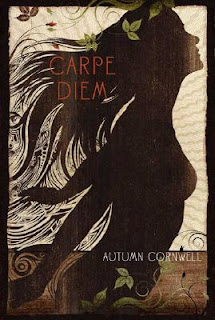
"Look how many boring novels get published every year in the name of literature."

which is not a comment on Autumn Cornwell’s young adult novel Carpe Diem, rather a quote from that novel which i just couldn’t resist.


Vassar (her mother always wanted to go to Vassar, and has now transferred that goal onto her daughter~figuring with the proper planning and that name, how could they possibly reject her???) Spore, sixteen, has her life plan set up through graduate school (as well as few life goals beyond that: (marrying a 6’5” blond surgeon {she’d settle for a judge} by age 25 {for love}; having three children by age 35 {two girls one boy}; publish the definitive book {subject as yet undecided} by age 37; and winning the Pulitzer prize). Her mother is not sure that is quite ambitious enough.


She has her life and schedule planned down to the minute, a trait she gets from her rather over-organized parents~her father the efficiency expert, and her mother the life planner (who gave up planning other people’s lives when Vassar came along to plan her daughter’s.


Vassar’s summer plans (to take AP English as well as a Sub-Molecular Theory course, and attend Advanced Latin Camp) are thrown into complete disarray when her Bohemian artist Grandma Gerd offers to take her on a summer trip through Southeast Asia. The thought is a completely outrageous and would throw her 5.3 GPA down the drain as well as kill any hope of her getting valedictorian (as opposed to the oh-so-evil Wendy Stupacker). To Vassar’s surprise, after some whispered conversation between her parents and the grandmother she has never met, they insist that she goes. It makes her “feel out of context.”


Of course the trip manages to awaken a few new dimensions in Vassar (else where would the story be found?) (And the only memories this novel brought up for me was when i was sixteen and stuck on the wrong Mexican side of the Tijuana border with nothing but the tee shirt on my back and the shorts on my ass~thongs on my feet~the paint from an earlier paint fight {we'd been painting a Tijuana orphanage} drying in the 100 plus degree heat~my brain so fried i couldn't remember my name when the border guards asked and fearing i'd never be let across~an experience which eerily almost repeated itself in Toronto when i was somewhat trying to flee Canada on a canceled plane ticket when the company i was working for decided i needed to stay longer than i thought i needed to and the border guards there wanted a passport i hadn't needed to enter the country... Oddly enough the Tijuanan trip was the same one where i lost a contact and had to keep switching the remaining one back and forth between my eyes from day to day to see~so there's another parallel...

Some plot elements i found a little predictable (i figured out the “Big Secret” quite early on) but what do you expect (did i find everything quite as predictable when i was actually a “young adult”~or do they make these “Big Secrets” not so “secret” to make us all feel so-very-clever and smug?)


The sentence and phrase “Poor Dad. Not only was he adopted, . . .” had me more than a little annoyed with Ms. Cornwell when i encountered it at the beginning of the novel (as if to say: not only was he adopted…as if that wasn’t bad enough…) but i tried to attribute it to the general smugness of the narrator, and the fact that Cornwell had was otherwise quite a witty and comedic storyteller (besides which she almost redeemed herself by the end of the novel.) Good for a check out.


Let each of us examine his thoughts; he will find them wholly concerned with the past or the future. We almost never think of the present, and if we do think of it, it is only to see what light it throws on our plans for the future. The present is never without end. The past and the present are our means, the future alone our end. Thus we never actually live, but hope to live, and since we are always planning how to be happy, it is inevitable that we should never be so.


~Pascal’s Pensées


Live In The Moment! (as they say)